Measuring Scale Length of Fretted Instruments
Accurately determining the scale length of a stringed musical instrument is nowhere near as simple as measuring from nut to 12th fret and doubling the result. Oh, that will work under certain conditions, but unfortunately those conditions are rarely met. Here is an analysis of the issues involved and suggestions for how to obtain accurate results. This article originally appeared in American Lutherie.
Initial appearance: May 20, 2026
Last updated:
May 21, 2026
Measuring Scale Length of Fretted Instruments
Copyright © 2019 R.M. Mottola
[This article originally appeared in American Lutherie #136.]
[Note: This article should be considered only as background material to the page on this site that directly addresses measuring scale length and fret placement. Go there first. Come back here only if you want that background information.]
During a recent project to resurrect an inexpensive old factory guitar from the 1920s I needed to accurately determine the scale length of the instrument. The guitar badly needed a neck reset, but it also had major intonation problems that could not be attributed to high action alone. Either moving the bridge location or replacing the fretboard with one of a shorter scale length would be required to get the instrument to play in tune. It turned out I would end up performing additional forensic analysis of the fret placement of the instrument and found it to have serious issues. As a result I decided to replace the fretboard. With the techniques to do this scale length analysis all fresh in my mind I figured it would be appropriate to document those techniques.
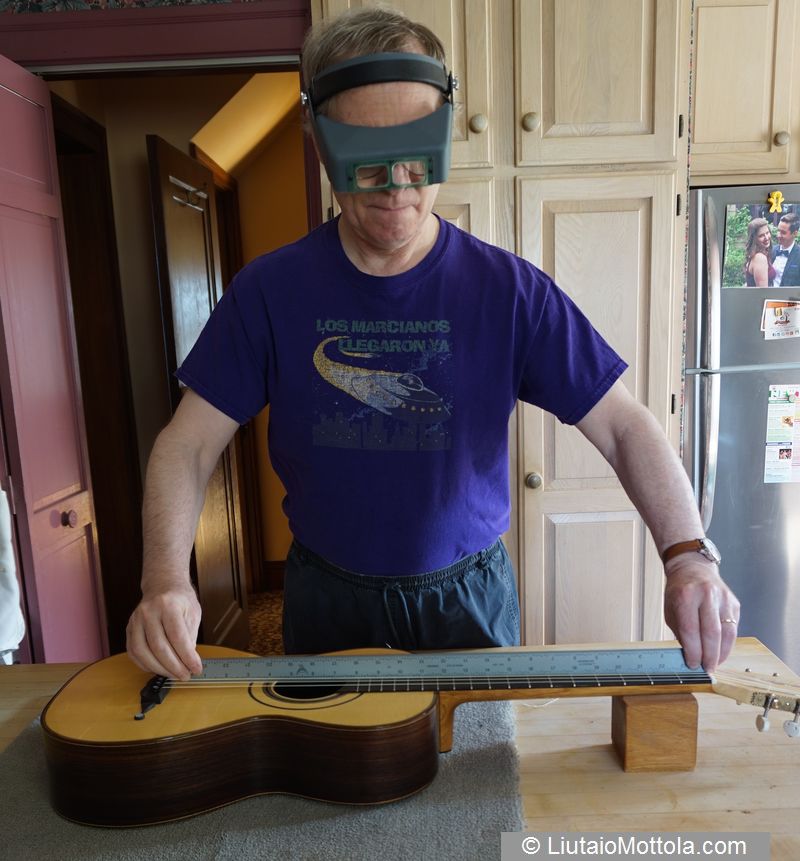
Photo 1 - Preparing to measure the distance from the nut to the 12th fret using a precision ruler. Good light and magnification are necessary to read the scale, on this ruler scribed in 100ths of an inch.
Ask around or peruse various Internet resources for advice on how to determine the scale length of a fretted instrument and the answer is usually to measure the distance between the nut and the apex of the crown of the 12th fret and then multiply this by two. Given accurate measurement technique this approach works fine, but only under the following conditions:
- The fret locations were originally calculated using the now conventional 12th root of 2 calculation;
- The 12th fret was accurately positioned when the fretboard was built;
- The nut was accurately positioned in relation to the rest of the frets.
Turns out that these conditions are hardly guaranteed.
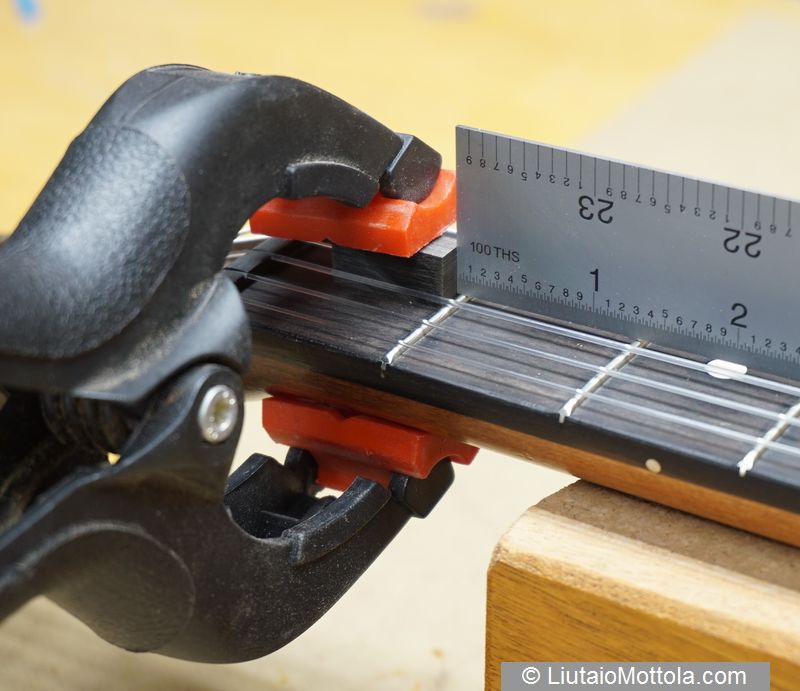
Photo 2 - When measuring from one fret to another it is useful to clamp a small block behind the fret to use as a stop for the end of the ruler. Since fret-to-fret measurements should be taken crown-to-crown, subtract half the width of the fret from the measurement.
Fret locations were traditionally determined for fixed fret instruments using the Rule of 18 (see the article "Was the Rule of 18 Good Enough?" in American Lutherie #130). It is unclear when this technique was generally replaced by the 12th root of 2 calculation, but it is safe to say you can expect to find it in all 19th century instruments and also in some instruments built well into the 20th century. If the Rule of 18 was used to lay out frets, the 12th fret will NOT be located at the midpoint of the scale length, it will be located approximately 0.1" (2.54mm) short of the midpoint of the scale length for a typical guitar.
In my cursory observation you can rely on most factory made instruments built from the 1960s onward to have frets located using the 12th root of 2. But in recent years a number of luthiers have made use of different fret location systems in a quest for more mathematically accurate intonation. See for example "A Simple Modification to Reduce Frequency Errors in Guitars" (American Lutherie #125) written by Mark French. It is safe to say that use of such systems is not widespread, but if you are attempting to measure scale length of a newer instrument you will need to be aware that one of these systems may have been used to lay out the frets.
A simple multiply the nut-to-12th-fret-distance by two approach also depends on accurate placement of the 12th fret. The accuracy with which frets are placed is probably lower when fret slots are cut by hand as opposed to being cut by a modern CNC machine. For factory built instruments there was a long period of time between those two eras, when fret slots were generally cut using a gang saw- circular saw blades spaced on a common shaft- or cut for groups of fretboards using a template and table saw. These approaches offer high repeatability but the resulting accuracy of placement of the fret slots would depend on the accuracy of placement of the saw blades on the shaft, or the notches on the template and the tolerances of the table saw. My limited look at some fretboards for this article indicates that accurate fret placement is not something that can be assumed. And any placement deviation of the 12th fret from its intended location will adversely affect any attempt at calculating scale length that uses that location.
The last requirement in the bulleted list above is that the nut is accurately placed relative to 12th root of 2 placement of the frets. Some modern instruments feature nut end compensation in a quest for more mathematically accurate intonation (see for example "Classic Guitar Intonation", American Lutherie #125 by Greg Byers). When this is done on a per-string basis it is pretty obvious that there is no simple "nut location" from which to measure to the 12th fret. But there are instruments that make use of subtle and not too obvious shortening of the distance from the nut face to the first fret. Some of this is intentional. My own classical guitars for example have this distance trimmed by 0.5mm. But it is also possible that this trimming is done unintentionally. The most common case of this is if the nut end of the fretboard is cut off using the fret saw, using the same location technique that was used to locate the saw to cut the fret slots, that is, by placing the saw directly over the fret placement mark so that mark will lie right down the center of the kerf. This is as you'd want things when cutting the fret slots of course. But if the saw is positioned this way when cutting off the nut end of the fretboard the nut ends up being half a kerf width (0.011" (0.28mm)) closer to the first fret than it should be (figure 1). This occult shortening of the nut-to-1st fret distance probably causes no harm and in fact will often improve mathematical intonation accuracy a bit, but it will affect the accuracy of attempts to calculate scale length. I'm sure most luthiers are aware of this issue and, if so desired during construction, will add the appropriate amount of distance when making this cut. But I have measured one instrument where the distance from nut to 1st fret is longer than it should be by half a fret slot width, possibly indicating some confusion on this matter.
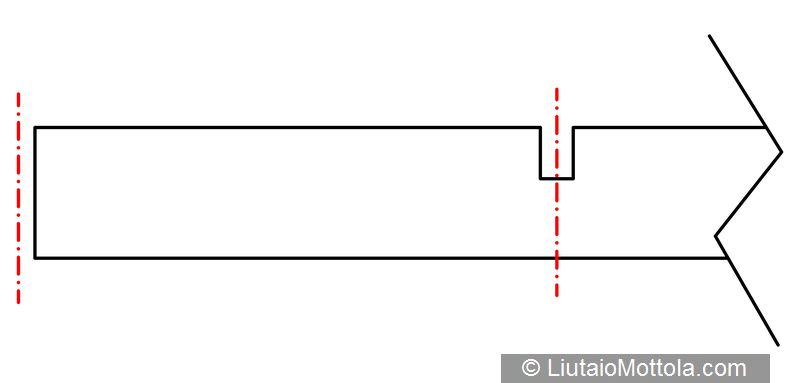
Figure 1 - Side view of the nut end of a fretboard. The fret slotting saw is generally positioned directly over the fret location so the fret crown will be properly located. But if the saw is positioned this way when cutting off the nut end of the fretboard the distance between nut and 1st fret ends up short by half the width of the saw kerf.
So, if it is possible to reliably determine scale length from double the nut to 12th fret distance only under certain conditions, and those conditions are not readily met or even determinable, how can the scale length be reliably figured out? What follows are instructions for a more reliable way to determine scale length as long as the frets were laid out using the 12th root of 2. Also included is analysis which can help you determine if the frets were indeed laid out using the 12th root of 2 or some other method. But unfortunately that latter analysis does not yield definitive results.
Since measurements from the nut may not be reliable because nut placement may not be accurate, the first thing to do is to instead measure the distance between two of the frets and then divide that distance by a factor specific to that fret interval. Measuring from the 1st fret to, say, the 13th and then dividing that distance by 0.471937 will give you a calculated scale length. This works with any units of measurement. Since that measurement does not involve the nut, any error in nut placement that may be present does not affect the calculation. But what if those two frets were not accurately located when the fretboard was built? In that case the calculated scale length will also not be accurate. But if instead of relying on just one measurement we take a few measurements between different frets and calculate the scale length based on each of these, and then average those calculated scale lengths together, we are likely to increase the overall accuracy of our results. In addition, plotting those values may tell us something about the calculation used to originally determine fret location, and it may tell us something about the general fret placement accuracy of the fretboard as well.
Table 1 lists the division factors that can be used to calculate scale length from distance between nut and a fret, and also from the distance between the 1st fret and some other frets, for instruments with frets positioned using the 12th root of 2. The derivation of these division factors may be interesting. I want to keep this article as free of math as possible so I won’t include the equations here. But if you go to any fret location calculator such as the ones found on my website (https://www.liutaiomottola.com/formulae/fret.htm) and request the fret locations for a scale length of 1, the calculator will return the nut-to-fret division factors shown in the first column of the table. And subtracting the nut to 1st fret value from each of those found in the first column will give you the division factors for distances from the 1st fret to each of the other frets as shown in the table.
| Fret# | From nut | From 1st | Fret# | From nut | From 1st | |
|---|---|---|---|---|---|---|
| 0 | 0 | 13 | 0.528063 | 0.471937 | ||
| 1 | 0.056126 | 0 | 14 | 0.554551 | 0.498425 | |
| 2 | 0.109101 | 0.052976 | 15 | 0.579552 | 0.523426 | |
| 3 | 0.159104 | 0.102978 | 16 | 0.60315 | 0.547024 | |
| 4 | 0.206299 | 0.150174 | 17 | 0.625423 | 0.569298 | |
| 5 | 0.250846 | 0.194721 | 18 | 0.646447 | 0.590321 | |
| 6 | 0.292893 | 0.236768 | 19 | 0.66629 | 0.610164 | |
| 7 | 0.33258 | 0.276454 | 20 | 0.68502 | 0.628894 | |
| 8 | 0.370039 | 0.313914 | 21 | 0.702698 | 0.646573 | |
| 9 | 0.405396 | 0.349271 | 22 | 0.719384 | 0.663259 | |
| 10 | 0.438769 | 0.382643 | 23 | 0.735134 | 0.679009 | |
| 11 | 0.470268 | 0.414143 | 24 | 0.75 | 0.693874 | |
| 12 | 0.5 | 0.443874 | 25 | 0.764031 | 0.707906 |
In the following figures I've calculated the scale length of real and theoretical instruments based on the distance from the nut to 1st fret (purple dot), 1st to 2 frets, 1st to 3rd frets, 1st to 4th frets, and 1st to 12th frets (blue dots). In general it is a good idea to measure longer spans, like 1st to 12th fret, 1st to 13th fret, etc. because doing so reduces the effect of measurement error. I’m using these short spans here just because I can measure them quite accurately with digital calipers, but the calipers I have only go up to 6" (152.4mm). I measured the 1st to 12th frets distances using a ruler ruled in hundredths of an inch, good lighting, and a magnifier (photos 1, 2). After I got the five scale length results I plotted them. Also added to each plot is a straight line which comes as close to all of the last four points as possible. These lines are drawn using a statistical technique called simple linear regression. I’m including that in the figures because it helps to see any trends that may exist in the calculated scale length data.
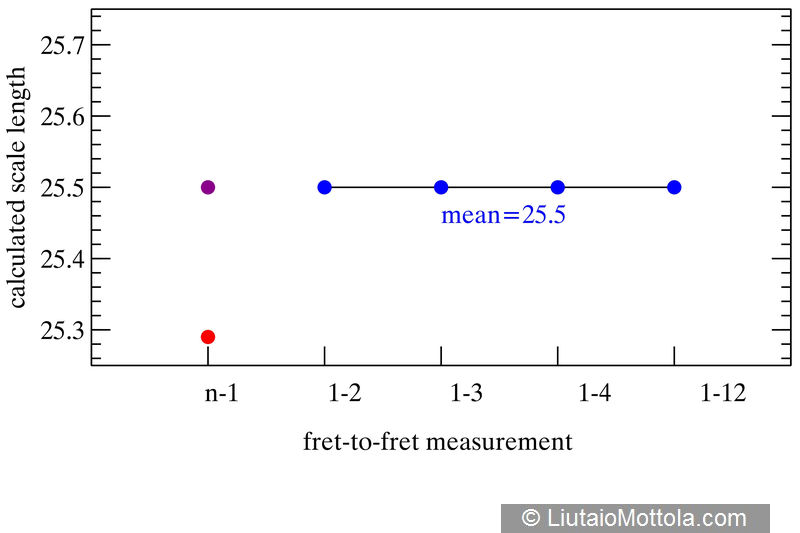
Figure 2 - Scale lengths calculated from nut-to-1st-fret distance (purple dot) and 1st fret to frets 2, 3, 4 and 12 (blue dots) using theoretical data for an instrument with 25.5" scale length instead of real measurements. The red dot indicates what happens to the scale length calculated from nut-to-1st-fret distance if the nut end of the fretboard is trimmed short, as indicated in figure 1.
Figure 2 is a plot of a theoretically perfect 25.5" (647.7mm) scale length instrument and error free measurement of the fret locations. The fret locations were calculated using the conventional 12th root of 2 method and were perfectly placed. And the nut to 1st fret distance is also perfect. As you can see all of the blue dots line up horizontally and the trend line goes right through each of them. Also notice the extra red dot plot at the nut-to-1st fret position. This indicates what happens to the nut to 1st fret scale length calculation when the nut end of the fretboard was chopped off without accounting for the width of the saw kerf, that is, shortened by 0.011" (0.28mm). The calculation yields a noticeably lower scale length value.
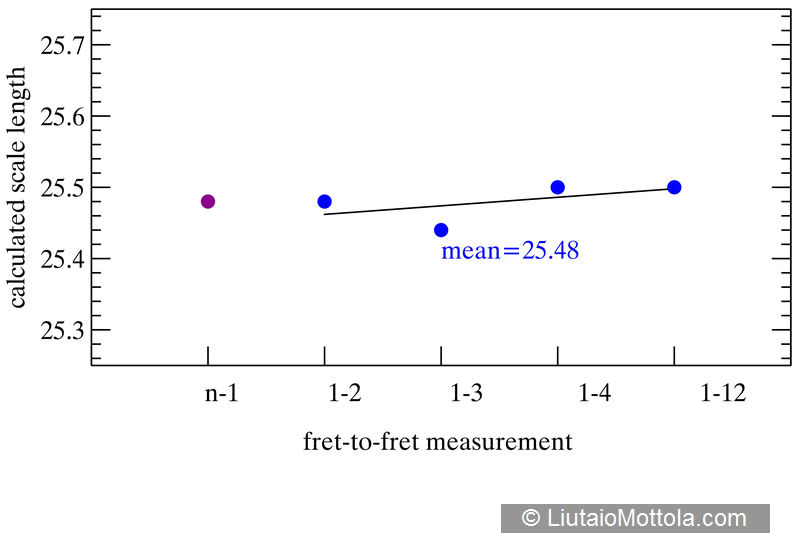
Figure 3 - Scale lengths calculated from nut-to-1st-fret distance (purple dot) and 1st fret to frets 2, 3, 4 and 12 (blue dots) using real measurements from an instrument built by the author with 25.5" scale length. The variability is small and is the result of combined manufacturing tolerances variability and unavoidable measurement error. Note that the trend line is nearly horizontal, which suggests the frets were laid out using the 12th root of 2 method. This level of variability is probably about as good as can be expected from a modern instrument and when using typical shop measuring tools.
Figure 3 is a plot of one of my own instruments. I’m including this here because it is a known entity. Scale length is 25.5" (647.7mm) and is calculated using 12th root of 2. Frets are located using the very accurate template and circular saw blade from LMI and the nut is located using this same template and appropriate offset for the kerf width. As you can see this plot closely matches that in figure 2 but there are small differences between the calculated scale length values. These differences are attributed to some combination of measurement error and manufacturing error, the latter mostly likely due to some side to side play in the miter gauge of my table saw. Note that these uncontrollable errors conspire to yield an average calculated scale length result of 25.48" (647.2mm), 0.02" (0.5mm) short of the actual scale length of the instrument. Note also that the calculated scale lengths based on the longer spans (frets 1-4 and frets 1-12) are more accurate than those that are based on the shorter spans. In fact they yield dead accurate results, which may indicate that any variability seen here is the result of measurement error only. This also makes a strong case to use longer spans when making these measurements.
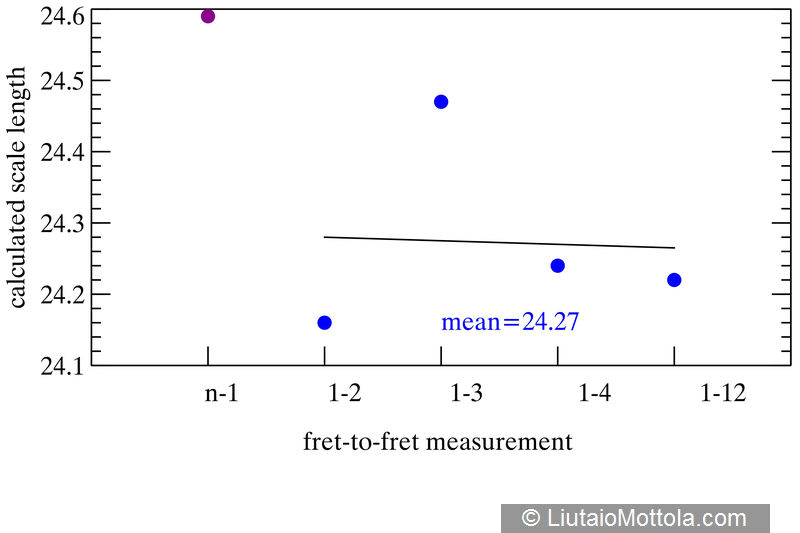
Figure 4 - Scale lengths calculated from nut-to-1st-fret distance (purple dot) and 1st fret to frets 2, 3, 4 and 12 (blue dots) using real measurements from an inexpensive factory instrument of unknown scale length built in the 1920s. The high degree of variability suggests that fret slots were either sawn by hand or using a fixture that was not well set up. But the nearly horizontal trend line indicates confidence in the mean scale length value.
In figure 4 I've plotted the results from the old and inexpensive factory guitar that got me started on this investigation. From this figure it is very apparent that fret location for this instrument was not very accurate – the dots are a considerable distance from the trend line. That the trend line is pretty flat (near zero slope) indicates that the 12th rule of 2 was probably used to lay out the frets. Note also that the purple dot, which represents the nut to 1st fret distance, is considerable higher than the rest, which indicates that location of the nut end of the fretboard was also not done with much accuracy. The high inaccuracy of fret and nut placement on this instrument was one of the things that convinced me that a new fretboard would be appropriate.
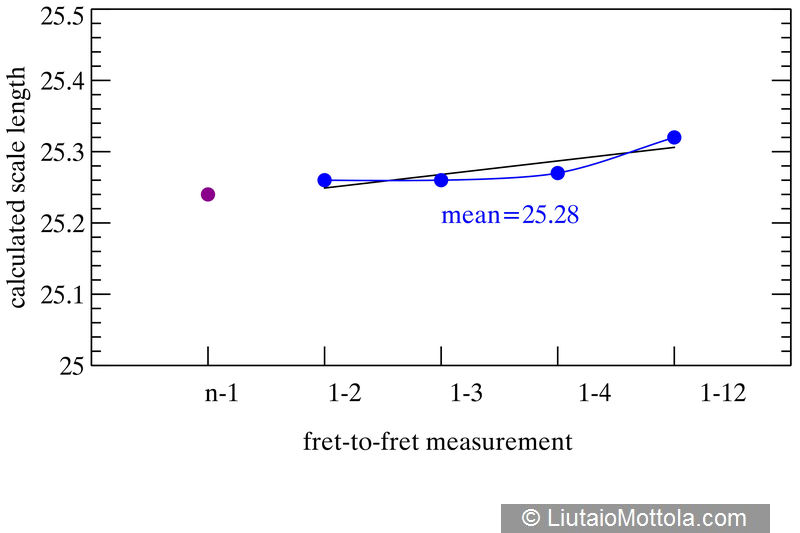
Figure 5 - Scale lengths calculated from nut-to-1st-fret distance (purple dot) and 1st fret to frets 2, 3, 4 and 12 (blue dots) using theoretical data for an instrument with 25.5" scale length with frets laid out using the Rule of 18. Note that all calculated values are considerably under the actual scale length. Note also the characteristic curve described by the values.
Figure 5 is another plot showing theoretical data, this one for a 25.5" (647.7mm) scale length instrument where the fret locations were calculated using the Rule of 18. You can see from the plot that none of the calculated scale length values are near 25.5 nor is the mean value. All are lower. The telltale sign that the frets were originally located using the Rule of 18 is that the calculated scale length values increase as the fret interval lengths increase. The relationship is nonlinear, and the calculated scale lengths describe a gentle upward curve.
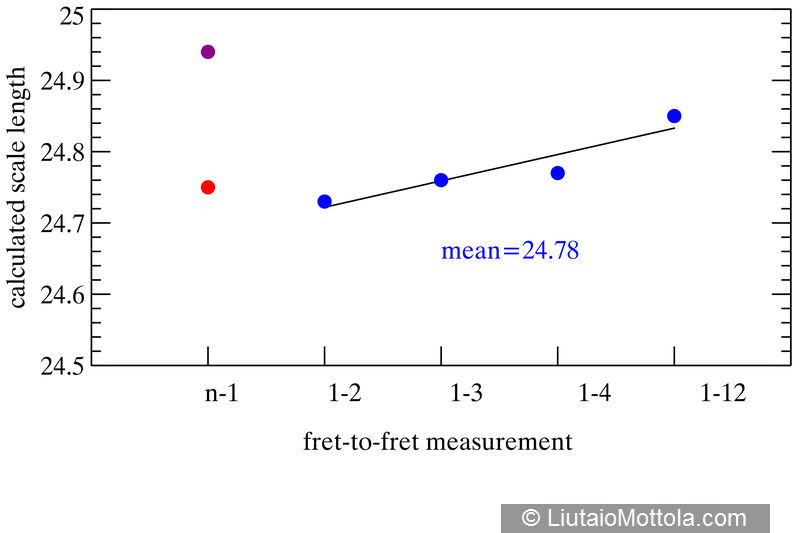
Figure 6 - Scale lengths calculated from nut-to-1st-fret distance (purple dot) and 1st fret to frets 2, 3, 4 and 12 (blue dots) using real measurements from a large-factory instrument of unknown scale length built in the 1990s. It is unclear from the data if the frets of this instrument were laid out using the 12th root of 2. The steep positive slope of the trend line suggests the possibility that they were not. The nut-to-1st-fret distance is unusually long. Note the red dot which represents a shortening of that distance by half the kerf width of a fret saw. This is more in line with the rest of the data.
Figure 6 is interesting because the instrument is a twenty year old guitar from a large North American manufacturer. Given its age and provenance I would expect frets to be laid out using the 12th rule of 2 and be accurately located, and no issues with placement of the nut. But as you can see the nut to 1st fret interval value is higher than that of the other frets and the trend indicates that the Rule of 18 may have been used to lay out the frets. Actually, the slope of the trend line is high enough that some value greater than 18 may have been used. Because the nut to 1st fret interval is so big, just out of curiosity I plotted an additional dot reducing this interval by half a fretting saw kerf width. You can see that (red) dot lines up much more closely with those for the other fret intervals. So my suspicion here is that the manufacturer knew they needed to compensate for the kerf width when cutting off the end of the fretboard, but they added a whole kerf width rather than the needed half.
This is a good place to point out that the only issue I am addressing in this article is the likelihood of obtaining accurate scale length estimation from measurements of a fretboard. It is tempting to imply that the more accurately and conventionally the frets are placed, the more accurate the instrument’s intonation will be. But it is not reasonable to imply this. There are many factors that influence intonation accuracy, and the relationship between fret placement and intonation is nonlinear. It is worth noting that although the instrument used to generate figure 6 has fret placement which makes it difficult to accurately determine scale length, that instrument has excellent overall measured intonation.
In summary, scale length can be accurately determined when multiple long span fret-to-fret measurements are taken and these are converted to scale length values using the division factors in table 1 and then averaged, as long as the fret locations were calculated using 12th root of 2 calculations. But of course we probably don’t know what calculations were used and it is not all that simple to determine what those were. If the trend line of calculated scale lengths is basically horizontal, the 12th root of 2 calculations were probably used. If scale length values increase with increasing fret-to-fret distances then this may indicate that the Rule of 18 or some other fret location calculation was used. And in this case the average scale length will not accurately represent the true scale length of the instrument. It may be possible to verify that the Rule of 18 was used by trying the analysis again, but this time using the division factors in table 2, which were generated using Rule of 18 calculations. If scale length values then appear in a horizontal line or if the trend line is then horizontal then it is likely the Rule of 18 was originally used to determine fret locations. But do keep in mind that fret location errors in manufacturing and measurement errors may make it difficult to accurately determine which calculations were used to determine fret location.
| Fret# | From nut | From 1st | Fret# | From nut | From 1st | |
|---|---|---|---|---|---|---|
| 0 | 0 | 13 | 0.524344 | 0.468788 | ||
| 1 | 0.055556 | 0 | 14 | 0.550769 | 0.495213 | |
| 2 | 0.108025 | 0.052469 | 15 | 0.575726 | 0.520171 | |
| 3 | 0.157579 | 0.102023 | 16 | 0.599297 | 0.543741 | |
| 4 | 0.20438 | 0.148824 | 17 | 0.621558 | 0.566003 | |
| 5 | 0.248581 | 0.193026 | 18 | 0.642583 | 0.587027 | |
| 6 | 0.290327 | 0.234771 | 19 | 0.662439 | 0.606884 | |
| 7 | 0.329753 | 0.274197 | 20 | 0.681193 | 0.625637 | |
| 8 | 0.366989 | 0.311433 | 21 | 0.698904 | 0.643349 | |
| 9 | 0.402156 | 0.346601 | 22 | 0.715632 | 0.660076 | |
| 10 | 0.43537 | 0.379814 | 23 | 0.73143 | 0.675874 | |
| 11 | 0.466738 | 0.411183 | 24 | 0.746351 | 0.690795 | |
| 12 | 0.496364 | 0.440808 | 25 | 0.760442 | 0.704887 |
A peripheral factor that may aid in interpreting scale length values derived by the methods described is a likely scale length for the instrument in question. Certain manufacturers made use of just one or two scale lengths for example, and if one of these falls within the range of calculated values then that may nail it down for you. Likewise calculated values that would be odd choices for scale length in the units of measurement used in the manufacture of the instrument may be suspect. So the calculated scale length for an instrument built using SI units of say 641mm might be suspect if a scale length of 640mm was possible. In this kind of forensic analysis you don’t always have as much data as you would like, and so it is often the case that you just have to go with the best estimate you can do given the information you do have.


